
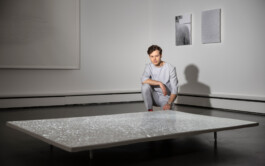

Drawing the landscape is both as frightening and liberating as the first step toward exploring an unknown continent. Beyond the measurable, point by point, step by step, from a single grain of sand through texture to form and space, nature continuously shapes the ground, as well as my body and mind. As these forms emerge, familiar ways of seeing begin to subside, making space for something else.
Biography
Jurgis Gečys (b. 1987, Lithuania) is an architect and visual artist based in Vienna. In 2014, he graduated with a Master’s degree in Architecture from the Academy of Fine Arts Vienna, where he later taught experimental architecture from 2023 to 2025.
His artistic practice spans drawing, sculpture, installation, and spatial work. Recent works include large-scale hand-drawn pieces made with pigment ink on paper, combined with manually embossed marks pressed into the paper’s surface.
In 2018, he studied at the Friedl Kubelka School for Artistic Photography in Vienna. His work has been supported by grants from the Lithuanian Council for Culture and the Austrian Federal Chancellery and has been presented at Kunstforum Wien, Fotogalerie Wien, Camera Austria, FOTO WIEN, Parallel Vienna, Galerie Martin Suppan and Bildraum 01, Vienna.
Across his journeys, Jurgis Gečys seeks out remote places where the elemental power of nature can be felt. In his preliminary studies, rugged coastlines, barren expanses, and imposing rock formations are transformed into restless lines. Like seismographs, they register the dynamics through which landscape takes shape: displacement, pressure, resistance. Before it becomes space, it is a field of forces.
As the work moves to a larger format, its rhythm shifts. What was spontaneous and volatile becomes slow, almost meditative. Point by point, the artist applies subtly varied inks to the paper. The drawing takes shape at the threshold between rigorous control and what escapes it. Contingency becomes part of the process. Points gather into dark fields, then disperse again. The eye is guided not by line but by a pulsation between density and void. At close range, the image dissolves into countless minute marks. Only from a distance do these coalesce into topography: mountains rise, rivers meander, horizons recede.
Geology here is far more than a visual reference; it informs the very logic of Jurgis Gečys‘ work. Accumulation, deformation, and erosion operate both as geological processes and as principles of drawing. The resulting landscapes seem at once observed, remembered, and imagined. Their spatial indeterminacy extends into time: within a single sheet, vastly different temporal scales converge: The Cambrian, the Neolithic, and the present fold into one another. It is this disparity of scales that gives Gečys’ drawings their distinctive tension: the smallest conceivable mark – a single point – meets the almost unimaginable duration of a landscape.
Text by Esther Hladik
Photo Credits
Eva Kelety
Light and Spaces
Studio Jurgis Gečys
@jurgisgecys
Imprint
Privacy Policy
© 2026